

(Image via meristation.com)
Staff Writer: Jesse Magnifico
Email: jmagnifico@umassd.edu
Thirty-eight years ago today, the first The Legend of Zelda entered the world.
Without Shigeru Miyamoto, the legendary Link, Zelda, and Ganon wouldn’t exist.
Miyamoto drew inspiration for the game from his childhood memories of the natural landscape where he grew up. He busied himself with the outdoors, hiking, climbing, and basking in the beauty of the forests, caves, and lakes near his hometown of Kobe.
When he began thinking about The Legend of Zelda (which he didn’t imagine would become a long-standing series), he pictured his players and asked, “What would they want to do? What would they feel in this situation?” He made it his goal for players to pave their own path and destiny in the eyes of malleable Link.
Link is, fundamentally, the player projected.
The series’ love from both Nintendo and fans all these years shows how a series can reshuffle a plot premise and execute iterations in new, exciting ways that keep gameplay fresh, original, and trailblazing — and oh-so-familiar. The Legend of Zelda is a favorite among game developers, too, who get a kick out of adding Easter eggs of the beloved characters.

Let’s dive down the Zelda timeline to explore what the game has brought to the table.
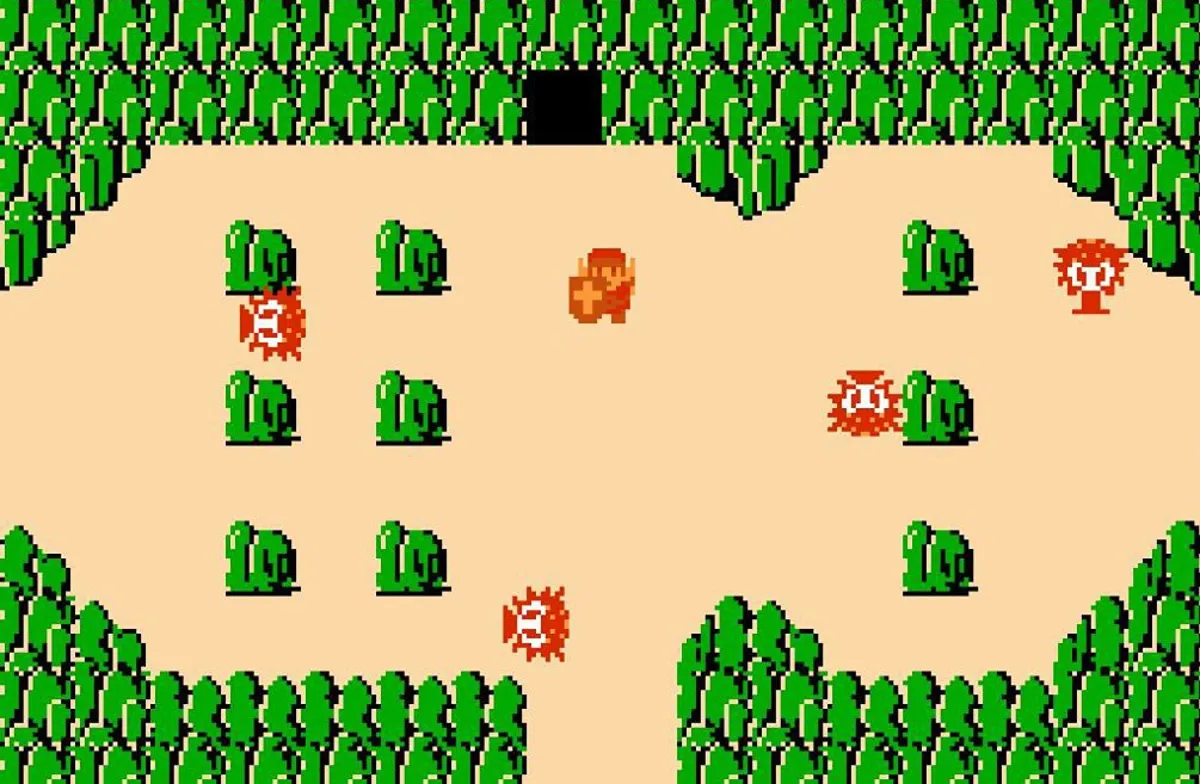
The Legend of Zelda (February 21, 1986)
Miyamoto went to the drawing board shortly after producing Super Mario Bros in 1985.
In the 80s, America and Japan became increasingly interested in video games. This was because they were a new form of entertainment. They weren’t mainstream yet, but they would shortly prove convenient by not only cutting the cost of constantly visiting the craze that was arcades in the 70s and 80s, but players could also enjoy games from their couch.
Save money by enjoying the arcade at home. It’s as simple as that!
The Legend of Zelda was created for the 1983 Nintendo Entertainment System (NES). Nintendo designed the NES to conquer the video game crash that happened in the same year and kill the Famicom Disk System.
Thanks to Nintendo, a save-game system finally came into the works, and the console allowed for bigger, albeit not better, graphics than an arcade.
The Legend of Zelda created a new subgenre of action-adventure by drawing in elements of exploration and puzzles from other games of the time period. It’s a big contributor to developing the rough beginnings of the RPG genre that was then fresh in Japan.
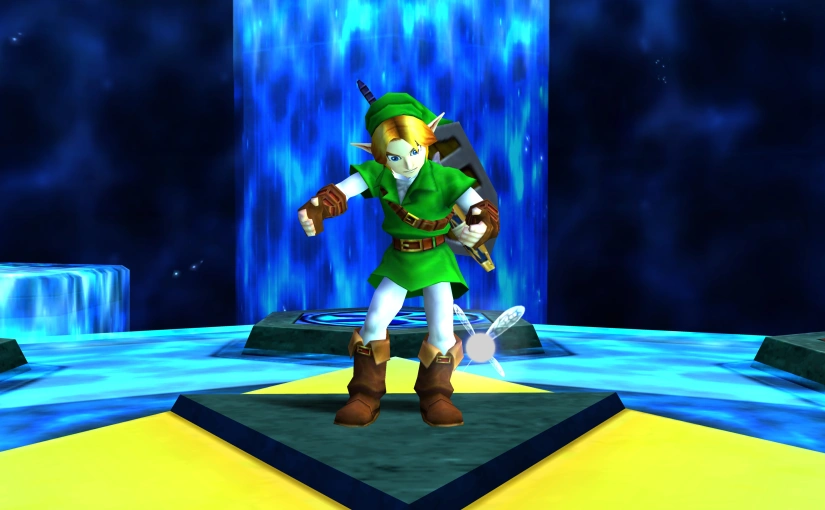
Ocarina of Time (November 21, 1998)
As the first Zelda game on the Nintendo 64 (N64), it is the first with 3D graphics.
The successor to the Super Nintendo Entertainment System (SNES), the N64 was only a year old when Ocarina of Time was released. 3D graphics were not the craze in game development yet, but they weren’t novel, either. The N64 highlighted the era of experimenting with 3D models alongside the PlayStation (1994) and Sega Saturn (1994).
The Lord of the Rings novels and Peter Pan deeply inspired Ocarina of Time. The game brought new features and gameplay abilities, making it Nintendo’s biggest game yet at 32 megabytes. Video games at the time typically consisted of a small single-digit megabyte or even a few kilobytes.
OoT’s massive size is due to 1,000 animation combinations.
The team wanted to make a good impression by entering the 3D modality with sexy, smooth animations. They didn’t consider motion capture until Miyamoto and the gang struggled to decide how Link should open a chest. Yes, a chest.
Entering 3D meant Link interacted with the world more realistically than his 2D iteration. Nintendo implemented new gameplay features that would carry over into nearly the rest of the titles: free camera control, lock-on targeting, and pressing a couple of buttons together to make Link perform actions like pushing a block or climbing a ladder.
The team begged and pleaded with the higher-ups to add the mo-cap technology to the budget, and once they agreed, it was a victory in game history.
Apparently, OoT Link is modeled after a “world-famous Hollywood actor.” It was the late 90s at the time of the game’s release — perhaps Leonard DiCaprio, who starred in Titanic (released in December of 1997), is the man in question.

Majora’s Mask (April 27, 2000)
The darkest, saddest installment, all produced in under a year — was never originally planned to be a standalone game.
After the success of Ocarina of Time, Miyamoto’s interest lied in further expanding its story. An early developmental prototype of Majora’s Mask under the title Ura Zelda or Zelda Gaiden was set to release as an expansion for OoT on a new system: the N64 Disk Drive (N64DD). The game would essentially act as DLC in a physical cartridge.
That endeavor soon dissipated when the N64DD suffered negative reception and horrible sales. Even then, its heavily delayed launch pushed Nintendo to reconsider development altogether.
The legwork for Majora’s Mask fell onto Eiji Aonuma, the OoT dungeon designer and appointed director for the new project.
There are two slightly different versions of Aonuma’s story. Still, he consistently points out he didn’t want to completely redesign Ura Zelda dungeons, which would remix (and ultimately erase) the extensive efforts he put into creating the Ocarina of Time.
Miyamoto made Aonuma quickly reconsider by proposing he could have his way if he finished the game within a year. Miyamoto suggested reusing models and assets from Ocarina of Time, saving Aonuma a lot of time.
The pressure to create an impactful story and engaging gameplay persisted even then.
Tasked with creating a new Zelda game from scratch in such a short timeframe, Aonuma pushed himself to constrain the bounds of Majora’s Mask’s world and add the gimmick of rewinding time as a way for players to discover something new each time.
“It’s useless to make something that the audience just skims over in one viewing, like a movie,” Miyamoto commented.
Despite a limited development time, Majora’s Mask is a fan favorite. Its dark story still resonates with players today.

Wind Waker (December 13, 2002)
Winder Waker was the first Legend of Zelda to feature open-world exploration without loading screens. Also, Toon Link becomes a staple iteration returning in The Minish Cap (2004), Phantom Hourglass (2007), and Spirit Tracks (2009).
Wind Waker entered development around the same time Majora’s Mask set sail for release. Eiji Aonuma directed the project again, with Miyamoto and Takashi Tezuka behind him as producers.
This next supposed installment of The Legend of Zelda was revealed in a 2000 Space World exposition, Nintendo’s showcase for upcoming games and developments. A short clip of Link and Gannon fighting premiered, the style reminiscent of Ocarina of Time with a twist of finer-tuned models.
Aonuma despised it.
“No, this isn’t Zelda at all,” he declared. “I felt like this wasn’t what I imagined Zelda to be. It wasn’t the Zelda I wanted to make.”
The culprit? The presentation was whipped up with haste. Nintendo rushed to push the reveal out.
The following year, the 2001 Space World introduced Aonuma’s vision of a Zelda game he wished to indulge in. The audience, with excitement built up for the next Ocarina of Time-esque installment, now didn’t know whether to clap or remain silent. They were largely confused and disappointed. What happened to the cool entry Nintendo promised?
When the game was finally released at the end of 2002, US sales were low because players strongly disliked the cartoon style. It was new and never implemented before in the series. Fans and players believed Nintendo tailored Wind Waker to children or that it was too childish for established fans.
The startling new style didn’t stop some from getting their hands on the disk, though. Soon enough, slowly but surely, thanks to the brave souls who trekked the mixed reception, players grew to love the game’s plot and gameplay mechanics. They began to relish the new take on the Zelda series. Soon enough, it registered as a fan favorite.
While developing, Nintendo originally intended one of the frog-esque deities, Cyclos or Zephos, to stay alongside Link as a little companion like Navi in Ocarina of Time. That idea was quickly scrapped, and thus, the frog deities were born.

Twilight Princess (November 19, 2006)
Twilight Princess is the spiritual successor to Ocarina of Time, but it didn’t enter development in 2003 that way.
Eiji Aonuma revealed Twilight Princess originally as a sequel to Wind Waker. Like Majora’s Mask with Ocarina of Time, the early rendition of Twilight Princess would reuse Wind Waker assets. There are still two unused, leftover WW models buried in TP’s data files: the cartoony bomb and conductor’s baton Wind Waker Link wields to control the winds.
Aonuma and Miyamoto designed Twilight Princess to avoid another Wind Waker incident, similar to the 3D style fans associate The Legend of Zelda with Ocarina of Time. Maintaining the image of OoT did not entice them to copy-and-paste assets verbatim like Majora’s Mask and create a new plot — not with Wind Waker’s performance haunting them.
This was 2003-2005. They channeled the power of the GameCube.
Nintendo (and fans) wanted the “realistic” style of OoT back and some mechanics that were perhaps the epitome of the series thus far. The design team yearned to bring back the gimmick of switching between forms to add a fun playstyle twist, as seen in OoT when he changes from child to adult and back again. They didn’t want to merely repeat the age-changing stunt, though.
Aonuma suggested Link could turn into a wolf, and the developers ran with it. They loved the idea.
Link was not originally supposed to have trusty Midna on his back. Miyamoto believed looking at a furred animal from behind with nothing visually interesting going on other than a flapping tail would be visually and engagingly dull for players.
Enter Midna.
Midna took several rounds of concepts before landing as the princess of the Twilight Realm. The team thought about reintroducing Sheik, but Midna reigned supreme. Instead, they pushed Sheikah’s model to Super Smash Bros Brawl.
You may have guessed that her name stems from “midnight” because twilight is a big theme of the game, and… Twilight, night… Midnight. Yeah.
Horseback fighting was a new mechanic the team was excited to add, but it took many months to perfect. To accurately portray horse movements and behaviors, Miyamoto tasked some of the production team to learn to ride horses and document their experiences. They weren’t required to master riding but to acquire as much anatomical and empirical research and references on horses to better portray Link as a skilled horse rider.
One last thing: Link is left-landed on the GameCube version but is right-handed on the Wii. This happened because Miyamoto flipped the Wii Version to address the awkwardness of swinging the remote with the right hand and seeing Link swing his sword in the opposite direction with his left (sorry, left-handers).

Skyward Sword (November 18, 2011)
Aonuma stepped back as a producer and entered Hidemaro Fujibayashi, the man behind Phantom Hourglass. Serving as director for Skyward Sword, Fujibayashi undertook the game as his first project for home consoles.
The team piggybacked off Twilight Princess to consider greater world expansion and exploration, with Aonuma and others feeling they didn’t “fully complete this objective.”
Producing the game for the Wii meant a lengthy development timeframe for nailing motion controls and button operations just right. The game was planned for a three-year development, but design and development setbacks ordered it to be delayed for two more years.
Miyamoto explains, “For us, games provide a structure for play, and if you’re making a sequel, you have to have that desire to improve, strengthen, and expand things right at the core of the project.”
The game underwent an “experimental” phase for the first two years of development, with the team attempting to answer the questions:
“How do we make a new Zelda game, and how should we go about it?”
It was another story for the Wii MotionPlus element, but Nintendo eventually worked it out. The debate of how players should swap items is resolved with the Wii remote acting as a cursor; the player waves around and manually selects items rather than assigning them to slots.
During development, Nintendo considered upgrading the music and orchestral experience to enhance player experience. Instead of solely area themes and adaptive tunes (e.g., when an enemy spots you and the music changes to a fight instance), Music Supervisor Koji Kondo introduced character “theme songs.” Certain melodies are played when the player engages with particular characters.
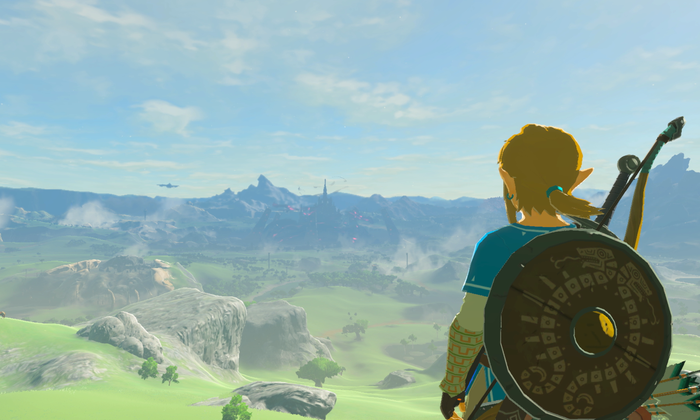
Breath of the Wild (March 3, 2017)
Breath of the Wild sits near the top as a critic and fan-favorite title, and for good reason.
Miyamoto’s attestation to “creat[ing] a game that convey[s] the same feeling you get when you are exploring a new city for the first time” stands as nothing short of an understatement for Breath of the Wild. Extend “city” to “continent,” and he has far succeeded in his goal.
This assertion isn’t a mere file size calculation (which BOTW does come in second place in the Zelda series, succeeded by Tears of the Kingdom, for being nearly fourteen gigabytes). Charlie Stewart’s GameRant has done the math: BOTW’s map clocks in at over eighty-four square kilometers, considering the grid, vast landscapes, and terrains.
For comparison, Cyberpunk 2077’s map is twenty-four square kilometers. A player walked from one corner of the map to the other (no sprinting, climbing, shield-surfing, speed enhancements, etc.), achieved in a little over forty-two minutes.
Aside from the game’s massive size, it is the first in the series to feature dedicated voice acting. All the titles before BOTW used text and sound effects to serve as character speech; however, Breath of the Wild switches it up for the first time in the series.
It’s not Link going “hyah!” and “hah!” but rather full-fledged spoken lines from voice actors. Zelda and the four champions/pilots of the divine beasts speak, but Link has yet to receive a voice. Players engage in dialogue options when speaking to characters, but he nonetheless remains silent. A mouth moves with no sound.
Link remains silent not solely because he is a stoic guy — Zelda’s diary proves he’s not mute or shy; he’s far from it — but because the producers wanted to give players the freedom to make Link be who they want him to be.
Link undergoes a massive design transformation within Nintendo and is widespread. Tailoring to the adoption into the LGBTQ+ community.
Eija Aonuma affirms, “Maybe Link is a boy or a girl… I really wanted the designer to encompass more of a gender-neutral figure. So I’ve always thought that for either female or male players, I wanted them to be able to relate to Link.”
Also, Robin Williams appears in Breath of the Wild as a traveling Hylian merchant named Dayto. The actor was a big fan of TLOZ, naming his daughter after Princess Zelda and dressing up as Link.
And one more thing: players finally receive a dedicated jump button thirty-one years into the series.